
One of the more recent examples of “Orientalism” (by way of Edward Saïd), at work in the fashion world appeared in the pages of British Vogue. For its June 2008 issue, the publication asked Rana Kabbani, the noted Syrian cultural historian, to write a two page essay addressing the myths surrounding the Oriental harem within the Western imagination.
Born in Damascus, Kabbani was educated at the American University of Beirut and Jesus College, Cambridge. After working as an art critic in Paris and a publisher's editor in London, she became a full-time writer in 1986. One her most important works was “Europe's Myths of the Orient: Devise and Rule” (1986), which examined Western perceptions of Islamic culture, paying particular attention to the creation of erotic stereotypes within European literature and painting. Her seminal book was later republished in 1994 as “Imperial Fictions: Europe's Myths of the Orient.”

In her article for Vogue, Kabani dispels many of the misconceptions surrounding the age old institution of sequestering women, by poignantly recalling her own grandmother’s life spent in a Damascus harem during the twilight years of the Ottoman Empire. Kabani’s words are surprisingly frank, direct and insightful, offering the reader an unvarnished viewpoint, far removed from the romanticized vision of 19th century Victorian painters. Ultimately her piece is a critique of cultural misrepresentations encouraged by such artists; noting that the women in such paintings were often portrayed as passive. When in reality, the harem (at the time) served as a venue for women to converse, work, entertain, and learn from each other in an environment, “relieved of the intrusive presence of their men.”
The “noisy, active, ferocious, brave, hard-working, opinionated and fun,” behavior that Kabbani witnessed in the harem women of her grandmother's generation is meant to humanize and give a face to the subjects of Orientalist paintings. She also makes the point that harem life was far less “exotic,” than what was portrayed in Western literature.

To look at the Oriental-inspired fashion spread on the preceding 6 pages provides an interesting social and historical counterpoint. Where Kabani’s essay attempts to shatter the myth, the photographer Janvier Vallhonrat and fashion editor Lucinda Chambers seem to perpetuate it. In a series of atmospheric images, the model Élise Crombez is captured lounging amongst embroidered pillows and a sea of Kilims, in scenes far removed from the thought-provoking world painted by Kabani. Despite this, what’s interesting about Vallhonrat’s images (when compared to that of his 19th century predecessors), is the hint of defiance in his subject’s eyes, and the suggestion of some form of struggle (through the use of hair and makeup).
Yet for all the analysis, what Vogue does best are beautiful images meant to inspire and take its readers on a journey (if only for a few minutes)…it’s just more interesting when a bit of social commentary is thrown into the mix.

 © THE POLYGLOT (all rights reserved) CHICAGO-PARIS




 Swedish-born Hollywood actress Ann-Margret plays an exotic night club dancer in “Rebus,” which was filmed in Beirut, 1968.
 One of the more recent examples of “Orientalism” (by way of Edward Saïd), at work in the fashion world appeared in the pages of British Vogue. For its June 2008 issue, the publication asked Rana Kabbani, the noted Syrian cultural historian, to write a two page essay addressing the myths surrounding the Oriental harem within the Western imagination.
 In her article for Vogue, Kabani dispels many of the misconceptions surrounding the age old institution of sequestering women, by poignantly recalling her own grandmother’s life spent in a Damascus harem during the twilight years of the Ottoman Empire. Kabani’s words are surprisingly frank, direct and insightful, offering the reader an unvarnished viewpoint, far removed from the romanticized vision of 19th century Victorian painters. Ultimately her piece is a critique of cultural misrepresentations encouraged by such artists; noting that the women in such paintings were often portrayed as passive. When in reality, the harem (at the time) served as a venue for women to converse, work, entertain, and learn from each other in an environment, “relieved of the intrusive presence of their men.”
 To look at the Oriental-inspired fashion spread on the preceding 6 pages provides an interesting social and historical counterpoint. Where Kabani’s essay attempts to shatter the myth, the photographer Janvier Vallhonrat and fashion editor Lucinda Chambers seem to perpetuate it. In a series of atmospheric images, the model Élise Crombez is captured lounging amongst embroidered pillows and a sea of Kilims, in scenes far removed from the thought-provoking world painted by Kabani. Despite this, what’s interesting about Vallhonrat’s images (when compared to that of his 19th century predecessors), is the hint of defiance in his subject’s eyes, and the suggestion of some form of struggle (through the use of hair and makeup).

 Looks from Paul Smiths’ Orientalist inspired Spring 2009 collection.
 Looks from Paul Smiths’ Orientalist inspired Spring 2009 collection.
 Looks from Miguel Adrover's Fall 2001 collection, inspired by the traditional Egyptian dress of the Nile Delta.
 Looks from Ralph Lauren’s Spring 2009 collection.
 “An Armenian Lady in Cairo, 1855,” by John Frederick Lewis was shown at "The Lure of the East," the Orientalist show at the Tate museum in London. The exhibit was the inspiration for Paul Smith’s Spring 2009 collection; A turbaned model at Chanel haute couture 1989, a look that can be traced back to 19th century Orientalist paintings.
 The French couturier Paul Poiret frequently found inspiration in the Orient, creating this “Harem” evening ensemble in 1910. The Ballets Russes, under the direction of Sergei Diaghilev, performed in Paris from 1909 to 1929. During that time it was considered one of the most influential theatre companies, sparking a vogue for all things Oriental when Léon Bakst created the costumes for Scheherazade. Paul Poiret was extremely influenced by Bakst's costume designs for the production, which included bold hues, heavy embroidery and harem pants.
 John Frederick Lewis’ “Harem Life in Constantinople,” 1875. A look from Ungaro’s Fall 1993 haute couture collection.
 John Frederick Lewis’ “Lilium Auratum,” 1871. A look from Jean Paul Gaultier’s Spring 1998 haute couture collection.
  Some of the most interesting interpretations of Oriental costume have come from designers known for a minimalist approach to dress. In this case, Jill Sander and Alberta Ferretti whittle down the caftan to its purist essence, Spring 1994.
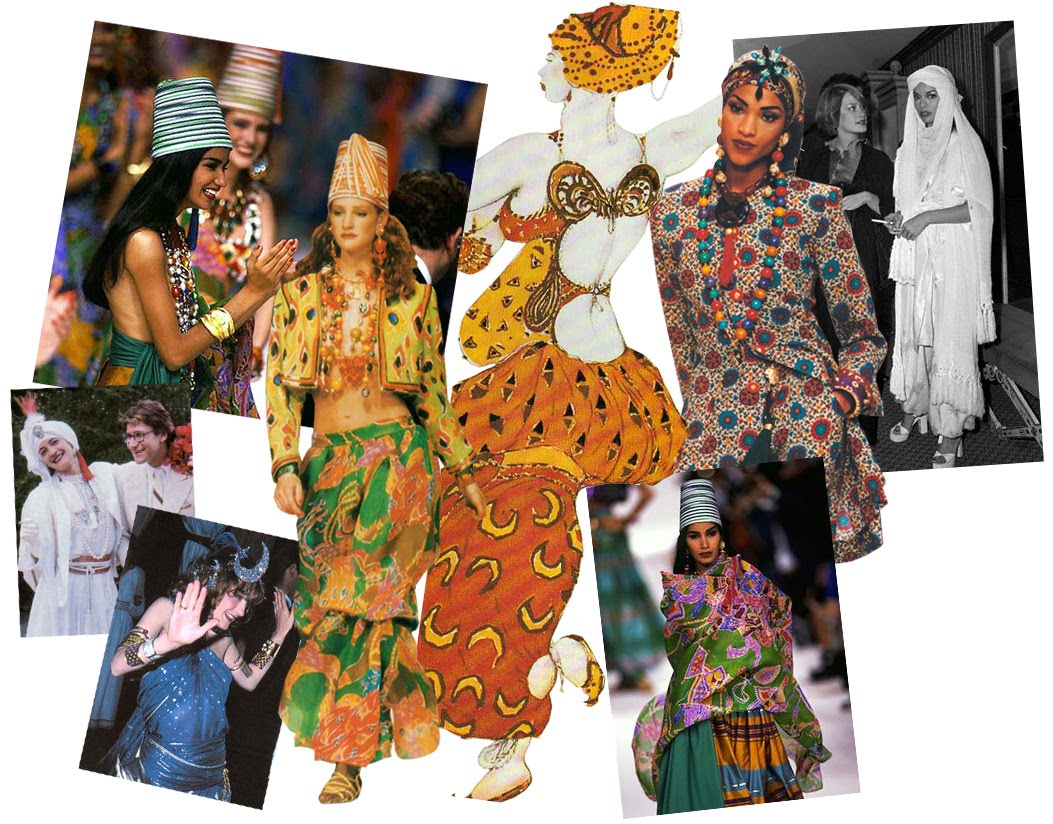 Yves Saint Laurent would also be inspired by the costumes of the Ballet Russe when he created a collection under the same name. Frequently referencing North Africa (and Marrakech in particular where he had a home), his Spring 1991 collection included colorful harem pants and fez’s inspired by Léon Bakst’s costumes; For Spring 1992 he designed a Moroccan inspired ensemble. Saint Laurent also created Oriental inspired designs for his close friends; In 1977 he designed two wedding outfits for his muse Lou Lou de la Falaise; Bianca Jagger in an oriental inspired outfit at New York’s El Morocco, 1975.
  For Fall 1994 London-based Turkish designer Rifat Ozbek showed one of his most influential collections in Paris (his first year showing there after presenting in Milan for several seasons). That year Ozbek was inspired by his Turkish roots and referenced Ottoman costumes. But take all those pieces apart and you had thoroughly modern clothes that were beautifully tailored, which was a hallmark of Ozbek.
 Looks from Rifat Ozbek’s Ottoman influenced Fall 1994 collection.


